Going over budget is the single most common nightmare in the construction industry. Whether you are a homeowner building your dream house or a professional contractor placing a bid on a commercial project, the story is always the same: the final cost significantly exceeds the initial estimate.
According to recent industry data, over 85% of construction projects experience cost overruns, with the average project running 16% over budget. But why does this happen? And more importantly, how can modern technology prevent it?
The truth is, most budget disasters aren't caused by sudden material shortages. They are caused by human error, outdated Excel spreadsheets, and the failure to account for the "hidden costs" of building. Here is how you can eliminate the guesswork and calculate exact, city-specific construction estimates in seconds.
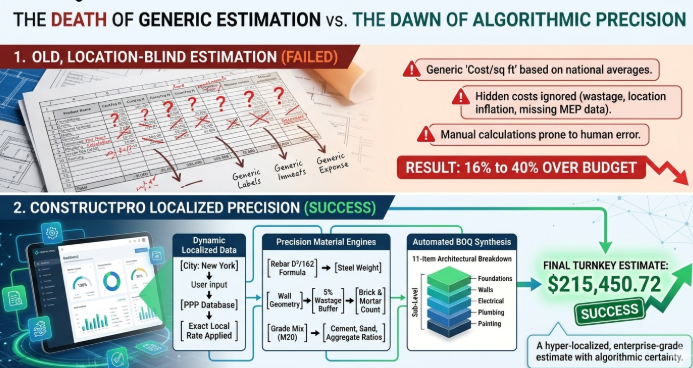
The Problem: Why Traditional Estimation Fails
For decades, project managers and home builders have relied on generic "cost per square foot" averages found on Google. This is a fatal financial mistake. Traditional estimation methods fail for three specific reasons:
- Location-Blindness: The cost of TMT steel, M20 concrete, and labor in New York is drastically different from the cost in London or Dubai. Generic calculators do not account for Purchasing Power Parity (PPP) or local inflation.
- The Wastage Factor: Manual calculations rarely account for material breakage. For example, tile and flooring projects typically suffer a 5% to 10% wastage rate due to edge cutting and transit damage. Failing to budget for this means halting construction to order more materials.
- Incomplete BOQs: A true Bill of Quantities (BOQ) requires an 11-item architectural breakdown (substructure, superstructure, MEP, finishes, etc.). Missing even one phase can throw off a budget by tens of thousands of dollars.
The Solution: Automated, Localized Estimation
At ConstructPro, we engineered a suite of professional estimation tools designed to replace broken spreadsheets with algorithmic precision. Built natively for engineers, contractors, and forward-thinking project managers, our tools process complex localized data in milliseconds.
🏗️ The Master Construction Cost Calculator
Stop guessing your turnkey costs. Our Construction Cost Calculator takes your total square footage and instantly generates a comprehensive 11-item breakdown. Most importantly, it applies exact city-specific multipliers, ensuring your estimate is hyper-localized to your specific territory.
📋 The Enterprise BOQ Generator
Creating a professional Bill of Quantities used to take days of manual data entry. With our BOQ Generator, you can synthesize substructure, superstructure, finishes, and MEP costs into a professional, export-ready report in under 60 seconds.
⚙️ Precision Material Calculators
To win competitive bids, you need to know exactly how much raw material to order. Our platform includes zero-latency micro-tools for specific structural needs:
- Steel Weight Matrix: Utilizes the precise D²/162 formula to calculate metric tonnage and bar quantities for all standard TMT diameters.
- Brick & Mortar Quantity: Determines exact brick counts and cement/sand mortar volume ratios for any wall geometry, automatically injecting a 5% wastage buffer.
- Concrete Mix Engine: Calculates the exact bags of cement, cubic feet of sand, and aggregate required for M15, M20, and M25 grades.
Protect Your Profit Margins Today
In construction, inaccurate data eats directly into your profit margins or your personal savings. You can no longer afford to rely on static, outdated formulas. By leveraging dynamic, city-specific calculation engines, you can bid with confidence, secure your financing, and build without the fear of hidden costs.
Start calculating your exact construction costs for free today →
📌 Frequently Asked Questions (FAQ)
How do I calculate the exact cost of building a house? To calculate the exact cost, you must multiply your total built-up area by your city's localized construction rate, then break that total down into architectural phases (e.g., 14% for foundations, 12% for brickwork, 15% for finishing). ConstructPro’s free Construction Cost Calculator automates this entire breakdown using real-time territorial data.
What is the D²/162 formula in construction? The D²/162 formula is an engineering standard used to calculate the unit weight of a steel reinforcing bar (rebar) per meter. By squaring the diameter of the bar (in millimeters) and dividing by 162, you get the exact weight in kilograms, which is crucial for ordering structural steel.
How much extra material should I order for wastage? Industry standards dictate a 5% wastage buffer for bricks and concrete, and a 10% wastage buffer for tiles and flooring due to cutting and breakage. ConstructPro's material calculators automatically layer these economic buffers into your final estimate so you never run short on site.
Comments (0)
Comments are reviewed before they appear. Please keep discussion relevant and respectful. Email is not requested.
No approved comments yet. Start the discussion.